

What Is On-Page SEO? A Complete Guide to Every Element
What is on-page SEO? A plain-English guide to the elements that decide how a page ranks, and how on-page differs from off-page and technical SEO.
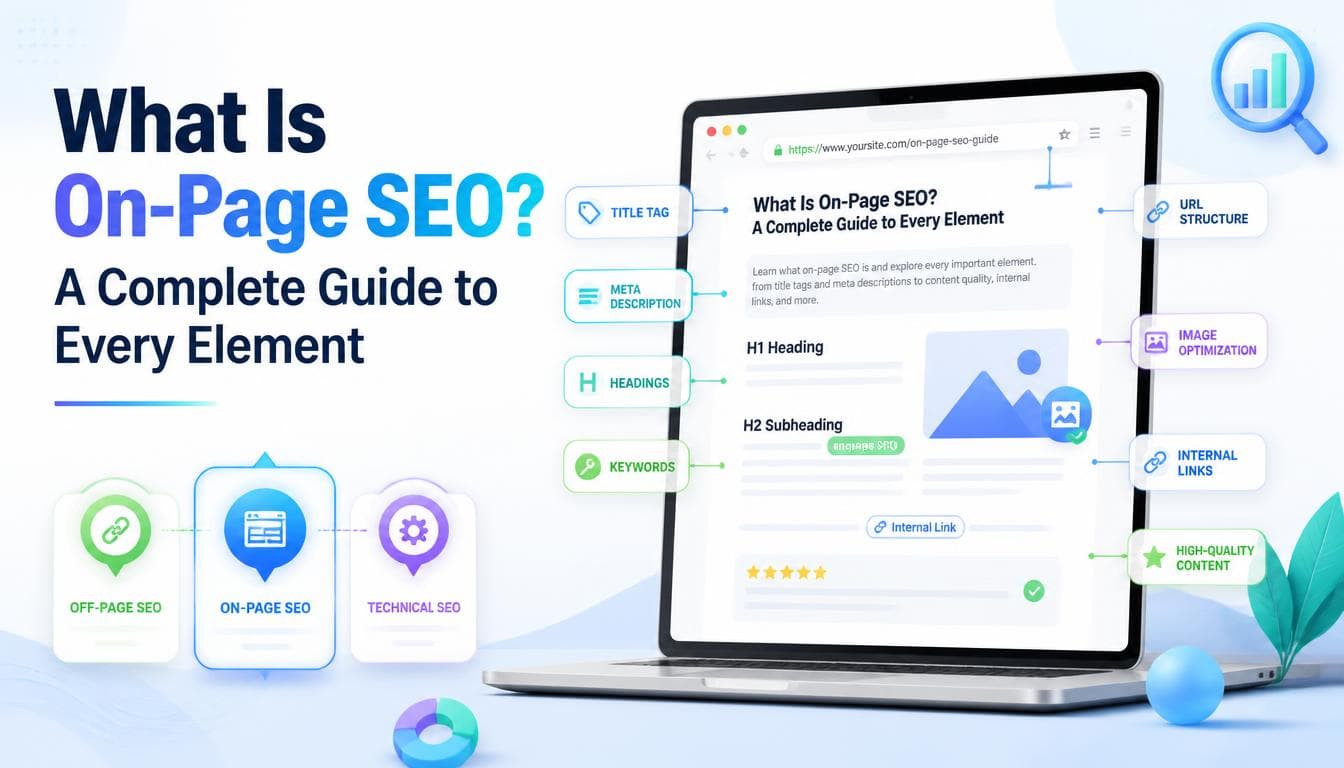
On-page SEO is everything you do on a page itself to help search engines understand what it is about and decide it deserves to rank for a particular search. That covers the words on the page, how they are structured, the title and description shown in search results, the links between your own pages, and the structured data that labels what the page contains. If you have ever asked "what is on-page SEO, and is it just keywords?", the short answer is no. Keywords are one input; the real job is matching a page to what the searcher actually wants, then making that match obvious to both the reader and the crawler.
What is on-page SEO, in one sentence?
On-page SEO is the practice of aligning a single page's content, structure and markup with one search intent, so the page becomes the most useful and most clearly labelled answer to that query.
"One search intent" matters more than it first appears. Most sites that struggle with on page work are not missing meta descriptions; they have several pages chasing the same query, and none of them wins it. Google has to pick one, often picks the wrong one, and swaps between them. Fixing that overlap, usually called keyword cannibalisation, is often worth more than any single tag change.
It is also the part of search you control most. You cannot force another site to link to you or make a query less competitive, but you decide exactly what your page says and how clearly it signals its topic.
The core on page SEO elements
None of these is a trick. Each one is a way of telling a search engine and a reader the same thing.
Search intent and the primary query
Before any writing, decide which query the page is for and what the person typing it wants. Someone searching "what is on page SEO" wants an explanation someone searching "on page SEO services" wants to hire someone. Those are different pages. Check what currently ranks: if the top results are all guides, a sales page will struggle, and the reverse is true too.
Title tag
The title tag is the clickable headline in search results and one of the strongest signals of what a page covers. Put the primary topic near the front, make it specific, and keep it within roughly 600 pixels, which is about where Google truncates desktop titles. Google does rewrite titles it considers unhelpful, so an honest, descriptive title is also the one most likely to be shown as written.
Meta description
The meta description does not directly affect rankings, but it does affect whether people click. Treat it as a short ad for the page: say what the reader will get, in plain language, in roughly 150 to 160 characters so it is not cut off mid-sentence.
H1 and heading structure
The H1 is the on page headline and should agree with the title tag without having to be identical. H2 and H3 headings should describe the sections beneath them, not decorate them. A reader skimming only the headings should be able to tell what the page covers, and so should a crawler. Clear headings are also how answer engines and featured snippets find self contained passages to quote.
The first hundred words
The title, the H1 and the opening paragraph should agree. If the page is about on page SEO, the first paragraph should say so and start answering rather than spend three sentences warming up.
Content depth and coverage
Depth is not word count. It is whether the page covers what someone searching this topic needs to know. The practical method is to read the pages currently ranking and list what they cover that yours does not. Genuine gaps become sections padding does not get written.
Internal links and anchor text
Internal links tell search engines which pages matter and what they are about. Link from related pages to the one you want to rank, using descriptive anchor text rather than "click here" or "read more". Internal links also move authority around a site, so a page that earns strong external links can pass some of that strength on.
URLs, images and alt text
A short, readable URL that reflects the topic helps people understand a link before they click it get it right at launch, because changing established URLs without redirects loses traffic. Alt text describes an image for screen reader users and for search engines, which cannot see it. Compressed images keep the page fast.
Structured data
Schema markup labels what a page contains: an article, a product, an FAQ, a local business. It can make a page eligible for richer results and helps machines interpret the content. The important part is validating it, and only marking up content that is actually visible on the page.
Signals of experience and trust
Google's quality guidelines talk about experience, expertise, authoritativeness and trust. On the page, that looks like a named author where it makes sense, clear sourcing, current information, and content that shows first hand knowledge rather than rephrasing what everyone else says.
On page vs off page vs technical SEO
SEO is usually split into three disciplines. They overlap, but they answer different questions.
On page SEO asks: is this page the best, clearest answer to its query? It covers content, headings, titles, internal links and schema.
Off page SEO asks: does the rest of the web vouch for this site? It covers earned links, digital PR, brand mentions and citation consistency, which is the work of our off-page SEO service.
Technical SEO asks: can search engines crawl, render and index the page at all, and is it fast enough? It covers crawl budget, JavaScript rendering, Core Web Vitals and migrations, which our technical SEO service handles.
The dependencies run in one direction. A page that is never indexed cannot rank, so technical problems come first. A page that is indexed but poorly matched to its query wastes the links pointing at it. And a strong page with no authority behind it can struggle on competitive terms. That is why a full SEO programme treats the three as one piece of work, even when the fixes ship separately.
Common on page SEO mistakes
- Several pages targeting the same query, so none of them ranks well.
- Titles written for the brand ("Home | Company Name") instead of for the searcher.
- Headings used for styling, so the outline makes no sense on its own.
- Content padded to hit a word count rather than to cover the topic.
- Important pages that receive almost no internal links.
- Schema added once, never validated, and left describing content that has changed.
How to start
Start with an inventory, not a rewrite. List every indexable URL and the query each one actually earns impressions for in Google Search Console. You will usually find overlaps, pages with no clear purpose, and pages nearly ranking for a valuable term. Resolve the overlaps first, then improve the near misses. When you are ready to go page by page, our on page SEO checklist turns everything above into a working list.
If the gaps are in the writing itself, our content writing service works from the same intent map. And because AI answer engines rely on the same clear structure, this work also supports optimising content for AI search.
This is exactly what our on page SEO service delivers: an intent map for every URL, rewritten titles and descriptions, a section by section content plan, an internal link map and validated schema, with rankings and clicks measured from the date each change goes live.
Frequently asked questions
What is on page SEO in simple terms?
On page SEO is the work you do on a web page itself so search engines understand what it is about and see it as a good answer to a search. It includes the content, headings, title tag, meta description, internal links, image alt text and structured data. The aim is to match each page to one search intent and make that match obvious.
What is the difference between on page and off page SEO?
On page SEO covers what is on your own pages: content, structure and markup. Off page SEO covers signals from elsewhere on the web, mainly links, digital PR and brand mentions, that show other sites trust yours. The two work best together.
Is technical SEO part of on page SEO?
They overlap but are usually treated separately. Technical SEO makes sure search engines can crawl, render and index your site and that it performs well, while on page SEO focuses on what each page says and how it is structured. Technical issues generally come first, because on-page improvements do nothing for a page that is never indexed.
How long does on page SEO take to work?
Search engines usually recrawl a changed page within days, but ranking movement typically takes a few weeks to a few months, depending on how competitive the query is and how much authority the site already has. Pages that were already close to ranking tend to move first.
Does word count matter for on page SEO?
Not as a target. What matters is whether the page covers the topic as completely as the searcher needs, which you can judge by comparing it with the pages that currently rank. Padding a page to hit a number usually makes it worse.
Written by the Getweys studio — Austin, Karachi, Auckland.