

How Much Does an Animated Explainer Video Cost? What Drives It
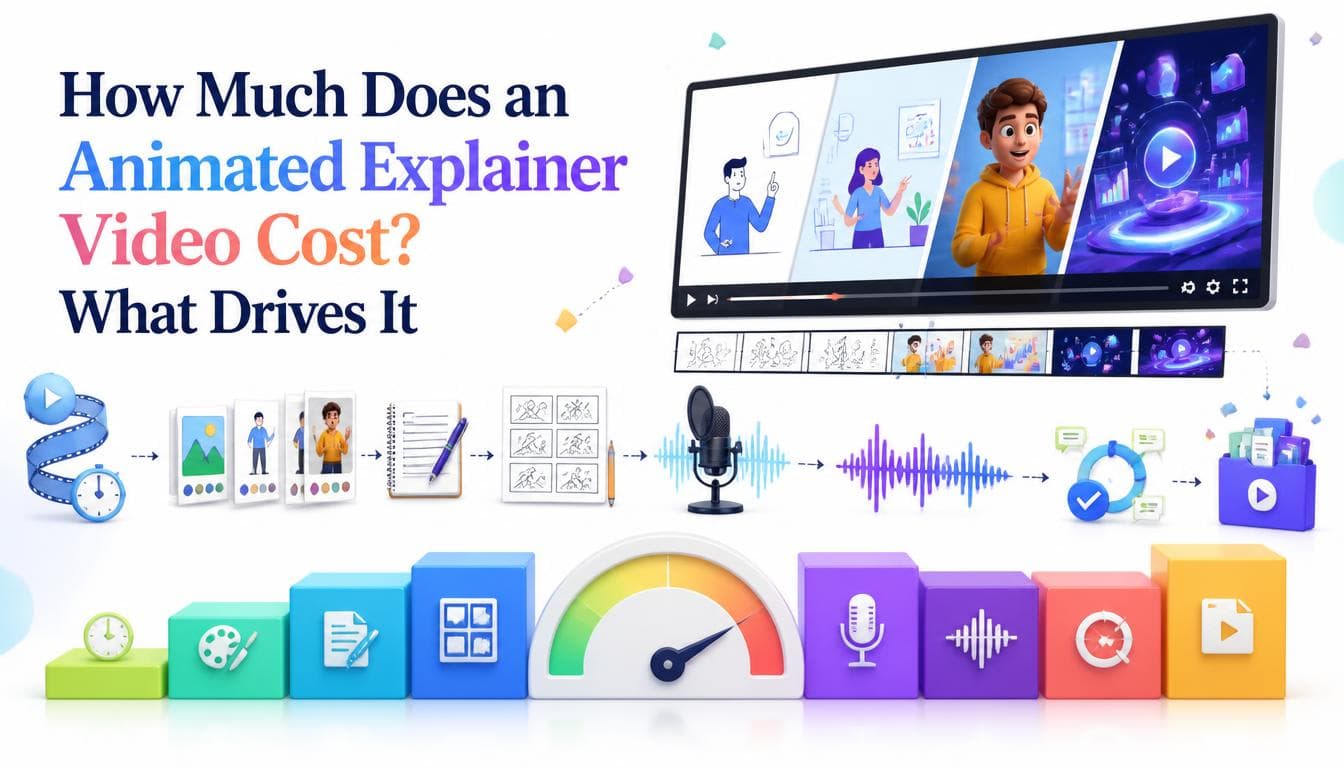
Ask five studios how much an animated explainer video costs and you'll get five very different numbers, and each of them can be fair. The price of an explainer isn't set by the minute of footage. It's set by the decisions behind that minute: how much has to be drawn, how much has to move, who writes it, and how many times it changes. This guide walks through what actually drives animated explainer video cost, so you can read a quote properly and decide where your budget does the most work.
Why explainer video quotes vary so much
Two videos of the same length can take very different amounts of work. A 60 second video built from animated icons and kinetic type is a different job from a 60 second video with custom characters walking through illustrated scenes. Both are "a one minute 2D explainer", which is why comparing quotes on length alone rarely tells you much.
Quotes also vary in what they include. One studio's figure might cover script, storyboard, voiceover, music and every social cut. Another's might cover animation only, with each extra added later. Before you compare numbers, compare scope.
The main factors behind animated explainer video cost
Length
Length is the most obvious factor, but it scales less neatly than people expect. Every scene has to be designed, illustrated and animated, so each extra 30 seconds adds real work. It's also the easiest lever to pull: a tighter script is almost always a better video and a cheaper one.
Illustration style and complexity
This is usually the biggest single driver. Roughly from simplest to most involved:
- Kinetic typography and icons, where text and simple shapes carry the story
- Flat motion graphics, with illustrated interfaces, diagrams and objects
- Character animation, where people move, gesture and react
- Detailed or textured illustration, with rich backgrounds and lighting
- Frame-by-frame animation, where each drawing is made by hand
The more custom drawing each scene needs, and the more of it has to move independently, the more time the project takes.
Script and concept work
Some clients arrive with a finished script. Most arrive with a product and a rough idea. Writing the script, testing the message and shaping the story is skilled work, and it's worth paying for, because a weak script can't be rescued by good animation. If a quote seems low, check whether scriptwriting is in it.
Voiceover and sound
Professional voiceover, music licensing and sound design each add cost. The voice talent's rates, the number of languages, and whether music is stock or composed all move the number. Sound is also where cutting corners is most noticeable to the viewer.
Revisions and approvals
Every studio builds a number of feedback rounds into its price. What costs extra is feedback that arrives late: changing the script after the voiceover is recorded, or redesigning a character after it's been animated in twelve scenes. The cheapest revision is the one made at the script or storyboard stage.
Deliverables and formats
A single widescreen file is one deliverable. A widescreen master plus square and vertical cut downs for social, captioned versions, a silent version for autoplay and alternative language tracks is a much larger delivery. Plan these up front, because building them into the storyboard is far cheaper than retrofitting them. If the video is part of a wider social media marketing push, share that plan with the studio early so the cut downs match the campaign.
Timeline
A compressed deadline usually means more people working in parallel, or work pushed ahead of other projects. If the launch date is fixed and close, expect it to show up in the quote.
What should be included in a quote
A clear explainer video quote should state, in plain terms:
- the finished length and number of versions
- whether scriptwriting and concept development are included
- the illustration and animation style, ideally with style frames before animation starts
- voiceover, music and sound design, and whether music licences are covered
- how many revision rounds are included, and at which stages
- the export formats and aspect ratios you'll receive
- who owns the final files and whether project source files are handed over
Our 2D animated video service covers the full chain from concept to final cut: scripting, storyboarding, motion design, animation, voiceover, sound and platform ready export. Whoever you work with, getting that list in writing is what lets you compare quotes on equal terms.
How to get more from your budget
You don't need to cut quality to control cost. You need to cut the right things.
- Shorten the script. Most first drafts can lose a third of their words and get clearer.
- Reuse assets. A small cast of characters and a consistent set of backgrounds can carry a whole series.
- Lock the script before anything is drawn. It's the single biggest saving available.
- Name one decision-maker. Conflicting feedback from several stakeholders is the most common cause of extra rounds.
- Plan the cut-downs early. Social versions designed into the storyboard cost far less than ones carved out later.
- Think in series. If you'll need several videos, commissioning them together lets the style and assets be built once.
Is it worth the investment?
An explainer earns its cost when it answers a question that's currently costing you customers or time. If your sales team repeats the same explanation on every call, or visitors land on a product page and leave without understanding it, a clear video can do that job every day without getting tired of it.
It's worth being honest about the alternatives, too. For a product people want to inspect rather than watch, a real-time 3D viewer or configurator can do more than a video, and our note on what an interactive website is explains where interaction beats playback. We build that side through our immersive web experiences work. For most abstract products and processes, though, a focused 2D explainer is one of the most efficient ways to make an idea land.
If you're still deciding on format and structure, start with our guide to 2D animated explainer videos, then come back to budget once you know what the video has to do. When you're ready for a scoped quote, get in touch with your brief and target length.
Frequently asked questions
What is the biggest factor in animated explainer video cost?
Style and complexity usually matter more than length. A video built from simple icons and typography takes far less work than one with custom characters and detailed scenes, even at the same running time. Deciding on style early is the most effective way to set a realistic budget.
Is it cheaper to write the script ourselves?
It can reduce the quote, but only if the script is genuinely ready. A script that's too long or tries to say too much will cost more in revisions later than professional scriptwriting would have cost up front. Many teams get the best result by drafting the key points and letting the studio shape them into a script.
Why do revisions sometimes cost extra?
Most quotes include a set number of feedback rounds at defined stages. Changes that come after a stage is signed off, such as rewriting a line after the voiceover is recorded, mean redoing finished work. Giving thorough feedback at the script and storyboard stages keeps revisions inside the original scope.
Should we pay for social media cut downs?
If the video will run on social platforms, yes, and it's best to plan them from the start. Vertical and square versions need to be considered in the storyboard so the key action stays in frame. Adding them at the end usually costs more and looks worse.
Do we own the final video?
That depends on the contract, so confirm it before you sign. Ask whether you receive full usage rights, whether music and voice licences cover all the places you plan to publish, and whether the editable project files are included for future updates.
Written by the Getweys studio: Austin, Karachi, Auckland.