

Website Content Writing That Converts: A Page by Page Guide
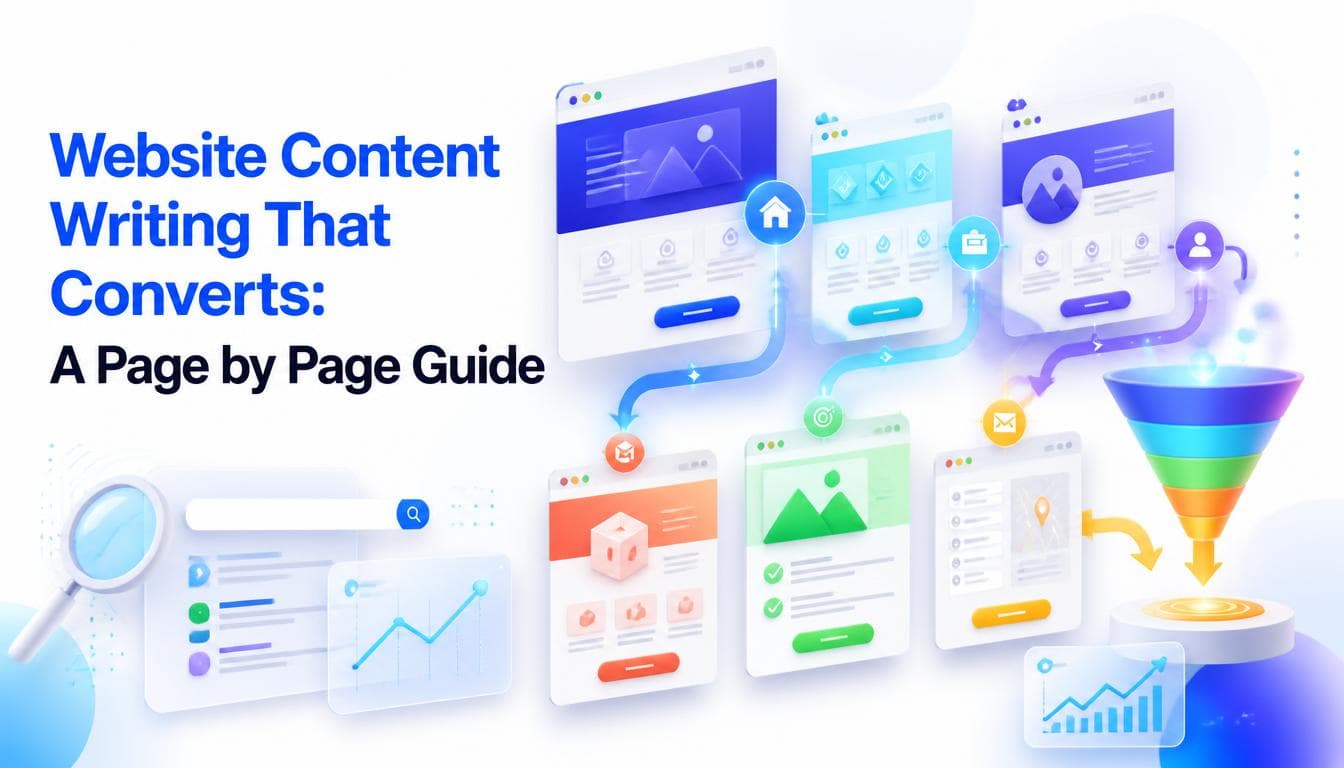
Most websites do not have a design problem or a traffic problem as often as they have a words problem. A visitor lands, reads a headline that could belong to any company in the industry, scrolls past three paragraphs about "innovative solutions", and leaves without understanding what the business does or why it matters to them. Website content writing that converts fixes that by answering the visitor's questions in the order they ask them, then making the next step obvious. This guide covers how to do that, page by page.
What "converts" actually means
A conversion is whatever action moves a visitor closer to becoming a customer: booking a call, requesting a quote, starting a trial, adding to cart, subscribing. Each page should have one primary action, and every piece of copy on that page should either build the case for it or remove a reason not to take it.
That framing changes how you write. Copy stops being a description of the business and becomes an argument addressed to one reader, with one goal. Anything that does not serve that argument is a candidate for cutting.
Start with the message, not the page
Before writing a single page, get four things clear. If they are fuzzy, every page will be fuzzy too.
- Who it is for. Name the reader specifically: "operations leads at mid sized logistics firms" is useful; "businesses" is not.
- The problem they have. Describe it in the words they would use, not in your internal vocabulary.
- What you do about it. One or two sentences a stranger could repeat back accurately.
- Why you rather than the alternatives. Including the alternative of doing nothing or doing it in-house.
This is where content writing meets brand. If your positioning and voice are not settled, copy will wobble between tones and claims. That is often the moment to work on the brand itself, and our guide on choosing a branding agency for your startup covers what that process should include. Visual identity and words need to say the same thing, which is why graphic design and branding and copy are best planned together.
The principles that make copy convert
Clarity beats cleverness
A clever headline that needs a second read loses the visitor who only gives it one. Say what you do, for whom, and what changes for them. You can be memorable once the reader already understands.
Specific beats general
"Fast turnaround" means nothing; "first draft within a week of the kickoff call" means something, provided it is true. Specific claims are more believable because they can be checked. Replace every adjective you can with a fact, a number you can stand behind, or an example.
Benefits, backed by features
Visitors buy outcomes, but they trust outcomes more when they can see the mechanism. Lead with what the reader gets, then show how, briefly. A feature list with no benefits is a spec sheet; benefits with no features sound like marketing.
Answer objections before they are raised
Every visitor arrives with doubts: is it too expensive, will it work for my situation, how long will it take, what happens if it goes wrong. Good copy names those doubts and answers them on the page, often in an FAQ, instead of hoping nobody thinks of them.
One call to action per page
Give each page one primary action, repeated where it makes sense, and make the button say what happens: "Book a 20 minute call" is better than "Submit". Secondary actions are fine, but they should be visibly secondary.
Page by page
Homepage
The homepage's job is orientation. In the first screen, a visitor should understand what you do, who it is for, and where to go next. Below that, give a short case for why you, the main paths into the site, and proof. Resist the urge to say everything; the homepage routes people to the pages that do the detailed selling.
Service or product pages
These pages do the heaviest conversion work and usually deserve the most writing time. Structure them around the buyer's questions: what is it, who is it for, what do I get, how does it work, what does it cost or how is it priced, why you, and what happens next. Each of those can be a section with a clear heading.
About page
About pages convert when they are about the customer's confidence, not the company's history. Explain how you work, what you believe about the problem, and who the reader will actually deal with. Keep the founding story short unless it genuinely explains why you are better at this.
Landing pages
A landing page built for a campaign should match the promise of the ad or email that sent the visitor there, word for word where possible. Remove the main navigation if you can, and keep every section pointed at the single action.
Contact page
Say what happens after someone gets in touch and how quickly. A form that asks only for what you genuinely need gets filled in more often than one that asks for everything.
Writing for search without writing for robots
Conversion copy and SEO are not in conflict. Search brings the visitor; copy persuades them. A service page should target the query its buyers actually search, use that language naturally in the title, heading and opening, and cover the questions that rank alongside it. The mechanics are covered in our guide to what on page SEO is, and our on-page SEO service maps each page to one search intent so pages do not compete with each other.
The mistake to avoid is the reverse: copy stuffed with keywords that no longer reads like it was written for a person. If a sentence exists only to repeat a phrase, it is costing you conversions.
Words and build go together
Copy that is written after the design is finished tends to get squeezed into boxes that were sized for placeholder text. The better sequence is message first, then page structure, then design, with the copy drafted early enough to shape the layout. If you are rebuilding a site, bring the writing into the plan from the start our web development projects work best when content and structure are decided together.
If you are handing the writing to someone else, the quality of what you get back depends heavily on the brief. Our guide on how to brief a content writer covers what to include.
Our content writing service handles website copy, SEO content and brand messaging, starting with research into your audience and competitors before a word is written.
Frequently asked questions
What makes website content convert?
Content converts when it clearly explains what you do and who it is for, answers the visitor's main questions and doubts, and gives each page one obvious next step. Specific, believable claims outperform general ones, and copy that matches what the visitor was searching for keeps them reading.
Should website copy be written before or after design?
Ideally before, or at least alongside. When copy is written first, the design can be built around the real message and length of each section. When copy is added afterwards, it is often cut or padded to fit layouts designed for placeholder text.
What is the difference between website copy and content writing?
Website copy is written to prompt an action, such as booking a call or making a purchase, and lives mostly on service, product and landing pages. Content writing, such as blog articles and guides, builds visibility and trust over time. Most sites need both, and they should share the same voice and message.
How long should website copy be?
As long as it takes to answer the visitor's questions and no longer. A simple product may need a short page; a considered purchase, such as a professional service, usually needs more explanation and proof. Cut anything that does not help the reader decide.
Written by the Getweys studio — Austin, Karachi, Auckland.