

THE DISTINCTIONS BETWEEN DIGITAL AND TRADITIONAL MARKETING
Traditional marketing refers to the execution of marketing initiatives through traditional media, such as radio, television, and magazines. On the other hand, digital marketing is the process of using the internet to advertise our business's goods and services.
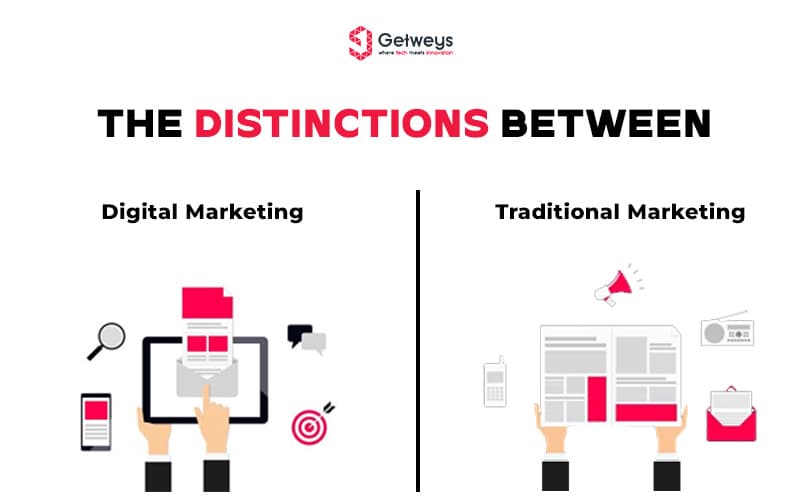
Traditional marketing refers to the execution of marketing initiatives through traditional media, such as radio, television, and magazines. On the other hand, digital marketing is the process of using the internet to advertise our business's goods and services.
Marketing is the set of activities that help a business promote its offerings and turn prospects into leads. Today's marketing takes on a completely different form—it is now digital instead of physical. Therefore, it is accurate to state that the typical person sees thousands of advertisements in a single day, whether they are traditional or digital.
Now that we've reached our topic, let's talk about how traditional and digital marketing differ from one another. Traditional marketing has a more localized reach, whereas digital marketing has a global reach—that is, people from all walks of life can view the advertisements that have been posted online—thanks to the power of digitalization.
Traditional marketing defined
Traditional marketing refers to the promotion of products and services through platforms, channels, and strategies that rely on one-way communication tools rather than two-way exchanges. It incorporates several, pricy, but instantly identifiable forms of advertising.
Put more precisely, traditional marketing is the standard approach to customer outreach that utilizes offline media such as radio, television, newspapers, magazines, posters, banners, and hoardings.
The primary goals of traditional marketing are audience reach and quantitative competition. This implies that the more people who view or interact with the advertisement, the more leads you will draw in.
What Makes Traditional Marketing Effective?
Traditional marketing is favored for the following reasons:
Simple Communication with the Target Audience: To simply reach potential customers, advertisements can be posted on the local news channels and newspapers in the relevant geographic area.
Save hard copies: Readers who are interested in an advertisement can keep the hard copies of the newspaper or magazine article so they can refer to it later on if they decide to purchase the good or service. Additionally, if their friends, family, or acquaintances need that product, they can give those copies to them.
Easily identifiable: Because traditional advertisements have been around for a while, people are accustomed to them and can recognize and understand them with ease.
High Reach: Due to the vast customer base of traditional marketing channels, a single advertisement can reach millions of local consumers in a single circulation. Additionally, this medium can also be used to reach residents of areas lacking network connectivity or internet connectivity.
What Digital Marketing Is Definition
In essence, the term "digital marketing" refers to the umbrella of all online marketing initiatives. Businesses that engage in digital marketing use every available digital channel to connect with both current and new clients. The channels could be websites, email, social media, Google search, and more. Moreover, the "Internet" is the most significant technological advancement that digital marketing depends on.
To put it simply, digital marketing encompasses all forms of online marketing that fall under its peripheral.
Many digital marketing agencies exist today that assist businesses in connecting with their target market, converting leads into customers, and maintaining long-term customer relationships.
utilising devices such as wireless media, websites, email, and smart televisions.
focuses on using electronic communication channels to establish and preserve a relationship with the clients.
Interested in expanding their clientele via digital means.
Why is digital marketing such an effective tool?
When it comes to digital marketing, the market is level. This implies that a new business will have the same opportunities as a well-established one. For this reason, the business that performs well overall typically prevails in the competition.
What Makes Digital Marketing Effective?
The following are the reasons why digital marketing is recommended:
Extremely Cost-Effective: Startups and small businesses with little capital can find more affordable and effective ways to market their goods and services.
Levels the playing field: Digital marketing creates a level playing field for all businesses by giving them the same and equal opportunity to draw in target clients, whether they are start-ups or multinational corporations.
Engage customers with compelling content: Content reigns supreme on the internet, and if you have compelling content, it will have an instant impact on your audience.
Boosts conversions: The success of digital marketing is frequently determined by the rate at which incoming traffic is converted into customers.
Increased revenue generation: Your company will make more money when customer engagement and conversion are higher. As a result, the companies can grow both locally and globally.
Developing brand awareness: By informing consumers about new products, deals, discounts, and other information, digital marketing assists businesses in developing brand awareness among their target audience.
Acknowledge Greater ROI: A business will eventually see a better return on investment if it can generate more revenue at a lower cost.
Important Distinctions Between Digital and Conventional Marketing
The following lists the distinctions between digital and traditional marketing:
- Conventional marketing refers to any form of campaign, promotion, or advertising that businesses have employed over the years to raise awareness of their goods and services through traditional media outlets like radio, television, newspapers, etc. Conversely, digital marketing is the process of using online marketing channels and strategies to sell and promote a company's goods and services.
- Digital marketing is dynamic in nature, while traditional marketing is static.
- Compared to traditional marketing, digital marketing has a faster rate of conversion from prospect to lead. This is since digital marketing is data-driven, displaying advertisements to users based on their preferences and interests, which produces qualified leads.
- The term "customer engagement" describes how a customer and a business communicate through various online and offline channels. Therefore, when comparing digital marketing to traditional marketing, the rate of customer engagement is higher. This is because, in the case of digital marketing, customers can view product details and other offers directly with just a click and are not required to visit the company's showroom to obtain product details.
- Traditional marketing makes it impossible to calculate return on investment, but digital marketing makes it simple to do so.
- Digital marketing is less expensive and more effective than traditional marketing, which is less effective.
- With digital marketing, it's simple to monitor the buyer's journey, the most viewed product, the number of customers who purchase the product, the interest level of the product, etc. However, it is completely impossible to track a customer in traditional marketing.
- Conventional marketing involves mass marketing with very little personal touch because it targets customers using standardized methods. Personalized digital marketing, on the other hand, shows customers only those products in which they have recently expressed interest or for which they have been searching the internet for some time.
- With traditional marketing, changes cannot be made after the advertisement is run. In contrast, changes can be made at any time—even after the advertisement has been placed.
- Since traditional marketing only reaches a particular geographic audience, its reach is localized to the area in question where the advertisement is displayed. However, because digital marketing makes use of the internet, the goods and services being advertised can find a market anywhere in the world. As a result, digital marketing is not limited to one field.
- As for the outcomes, conventional marketing takes some time to display the marketing activities' effects. However, marketers can see immediate, real-time results from digital marketing.
- With traditional marketing, customers are obligated to watch the advertisements; with digital marketing, however, they have the option to ignore or skip any advertisements that they find uninteresting or of no use.
- In contrast to digital marketing, which is a two-way communication where customers provide feedback about the products and services in the form of reviews and other forms of feedback, traditional marketing is a one-way communication in which the company spreads information about the product or services offered.
Types of Traditional Marketing
The following lists the different traditional marketing formats:
Print marketing
Newspapers, journals, posters, magazines, pamphlets, and other publications that provide daily news, classified ads, and interest-based periodicals are among them. These publications are funded by local advertisements and promotions.
Broadcasting
It might include radio and television, which offer entertainment as well as knowledge, information, and news. It is supported by commercials.
Outdoor marketing
Hoardings and billboards are two types of home marketing that have a significant long-term impact on consumer behavior.
One-to-one marketing
It includes telemarketing and SMS marketing, which is the practice of promoting goods and services to customers over the phone or through text messaging.
Direct mail
Also known as a mailshot or advertising mail. It is the procedure for mailing out promotional materials to the public. Brochures, postcards, flyers, catalogs, newsletters, and sales letters are all included.
Referral marketing
Also referred to as "word of mouth" marketing, this strategy relies on clients spreading word about the goods and services.
Types of digital marketing
The following are a few of the most popular digital marketing strategies or forms:
Search engine optimization
to improve your website so that it appears in the search results at the top. increasing the website's organic traffic as a result.
Content marketing
creating, disseminating, and advertising content for the intended audience in order to raise awareness of the brand, boost traffic, produce leads, etc.
Inbound Marketing
the process of helping potential clients find your business through branding, content marketing, social media, etc. It entails drawing in, winning over, closing, and satisfying clients.
Social media marketing
It's the process of advertising your brand on social media sites like Snapchat, LinkedIn, Instagram, Facebook, and Twitter. This increases traffic, generates leads, and raises brand awareness.
Pay per click
It is a form of advertising in which the publisher receives a predetermined payment from the advertiser each time an ad for the advertiser company is clicked. This model is typically used to increase website traffic. Ads may have appeared on Google and Bing search results pages.
Affiliate marketing
It is a technique whereby you advertise other businesses' products on your website and get paid a percentage of each sale that is made.
Native advertising
A style of advertising that mimics the content and purpose of the media that it runs in. These are called that because the advertisement would blend in with the native or free content, making it difficult for the consumer to recognize that it is an advertisement. Such advertisements are frequently seen on Facebook and Instagram as "Sponsored Ads."
Marketing automation
A program made to efficiently carry out marketing operations across multiple platforms and automate tedious chores like sending emails, etc.
Email marketing
Sending emails to a specific audience about sales, events, new products, offers, and other information while directing them to the company website is known as email marketing.
Online PR
It stands for online public relations, which is the practice of marketers using readily available online platforms—such as social media, blogs, websites, etc.—to carry out public relations campaigns.
In summary
To sum up, we can say that while digital marketing has changed recently, its popularity has surpassed that of traditional marketing because of its many benefits, chief among them being its ability to deliver results at a lower cost. Nevertheless, astute businesses combine the two to forge solid bonds with their leads, customers, and prospects.
Written by the Getweys studio — Austin, Karachi, Auckland.